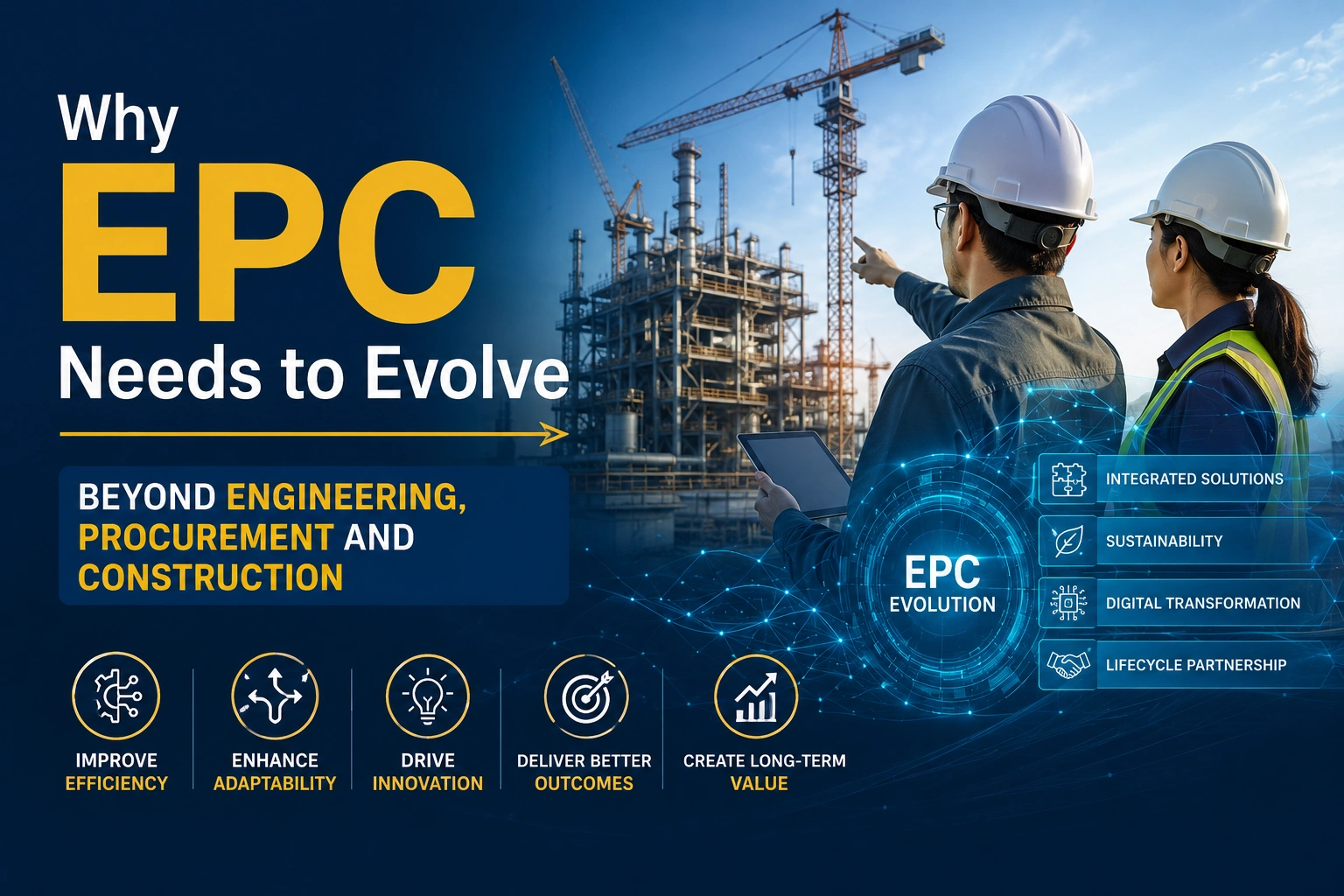
Why EPC Needs to Evolve Beyond Engineering, Procurement and Construction
For decades, EPC has provided a clear framework for delivering complex infrastructure: Engineering, Procurement and Construction.
But the infrastructure being delivered today is becoming far more complex than the traditional EPC model was designed to handle.
A data center is no longer simply a building with electrical and mechanical systems. A manufacturing facility is no longer just a plant with production equipment. Energy infrastructure increasingly needs to interact with variable renewable generation, storage systems, digital controls and increasingly sophisticated power-management requirements.
At the same time, project owners are looking beyond construction completion. They are concerned about speed to operation, energy efficiency, supply-chain resilience, scalability, lifecycle performance and the ability of infrastructure to adapt to changing requirements.
This raises a larger question:
If the projects are changing, should EPC remain defined only by engineering, procurement and construction?
The answer may lie not in replacing the EPC model, but in expanding what it is expected to accomplish.
The EPC model was built around project delivery
The traditional EPC structure brought three major activities together.
Engineering translated project requirements into designs and specifications.
Procurement converted those specifications into equipment, materials and vendor relationships.
Construction brought the designed project together on site.
This model created a valuable degree of coordination and accountability. Instead of an owner managing multiple disconnected contractors, EPC created a more integrated route from design to physical completion.
That value remains.
The challenge is that physical completion is no longer the only measure of project success.
A project can be completed on schedule and still face questions around its operating efficiency, energy consumption, scalability, technology integration or long-term resilience.
That changes the role expected from an EPC ecosystem.
Infrastructure is becoming an interconnected system
One of the biggest changes is happening at the intersection of industries.
Consider a modern data center.
Its infrastructure involves electrical systems, cooling, backup power, energy storage, fire protection, networking, physical infrastructure and increasingly high-density computing requirements. The availability and quality of power can directly influence the facility’s ability to operate.
Now consider a manufacturing facility.
Its requirements can extend across production infrastructure, automation, electrical distribution, process utilities, material movement, energy management and digital systems.
Energy storage adds another dimension.
A BESS project sits at the intersection of power generation, grid infrastructure, battery technology, power electronics, software and energy management.
These are not isolated engineering problems. They are interdependent infrastructure systems.
As this convergence increases, EPC cannot operate purely as a sequence of engineering, procurement and construction activities. It needs to understand how these disciplines interact with the broader operating environment.
Energy is becoming part of the infrastructure conversation
Energy is perhaps the clearest example of this shift.
India’s growing industrial and digital infrastructure is increasing demand for reliable electricity while the power system itself is undergoing a major transition.
Renewable energy is expanding. Energy storage is gaining importance. Data centers are increasing power density. Industries are looking more closely at energy efficiency, resilience and power quality.
As a result, decisions about infrastructure increasingly intersect with energy decisions.
A facility’s electrical architecture can influence its resilience.
Its energy-storage strategy can influence how it responds to grid conditions.
Its cooling design can influence its overall energy consumption.
Its power requirements can influence where and how a facility can be developed.
This means the EPC conversation is moving from “How do we build this?” toward “How should this infrastructure function within the larger energy system?”
That is a considerably broader question.
Procurement is no longer just about purchasing
The same shift is visible in procurement.
In a conventional project discussion, procurement can appear to be a straightforward transition between engineering and construction: specifications are prepared, vendors are identified, equipment is purchased and materials reach the site.
But global supply chains have made procurement a strategic consideration.
Long-lead equipment can influence project schedules. Imported components can introduce currency and logistics exposure. Concentration of supply in particular geographies can create vulnerabilities. Changes in technology can make specifications outdated before procurement is complete.
For complex infrastructure, therefore, procurement needs to contribute to project resilience, not simply project availability.
Engineering decisions need to consider supplier ecosystems.
Procurement needs to consider lifecycle requirements.
Project planning needs to account for technology changes and supply-chain realities.
The three traditional EPC functions are still present, but the boundaries between them are becoming less distinct.
The real shift is from project completion to operational readiness
This may be the most important evolution.
Historically, an EPC project could be judged largely by whether it was delivered according to agreed scope, cost and schedule.
Those metrics remain important.
But owners increasingly need to know what happens after handover.
Will the facility operate efficiently?
Can its capacity be expanded?
Can new technologies be incorporated?
Can the energy system adapt to changing loads?
Can critical infrastructure be maintained without major operational disruption?
These questions bring lifecycle thinking into the EPC conversation.
It means EPC participants need to understand not just how infrastructure is constructed, but how it will operate.
That distinction matters.
A project designed only for completion may produce a functioning asset.
A project designed around operational requirements has a better chance of producing infrastructure that remains useful as those requirements change.
Digital infrastructure is accelerating the change
Digitalisation is another force pushing EPC beyond its traditional boundaries.
Projects are increasingly dependent on data — from design coordination and procurement tracking to asset information, monitoring and operational analytics.
For infrastructure with complex systems, digital tools can improve visibility across the project lifecycle.
But digitalisation also changes expectations.
A facility may need to be designed with monitoring and control systems from the outset. Equipment may need to communicate with broader energy-management platforms. Asset information generated during engineering may become useful during operations.
This creates a connection between project data and operational data.
The EPC industry therefore has an opportunity to treat digital information not merely as a project-management tool, but as part of the infrastructure being delivered.
Manufacturing is changing the scale of the challenge
India’s manufacturing ambitions add another dimension.
As manufacturing capacity expands, the infrastructure required to support it becomes more sophisticated.
Factories increasingly depend on automation, high-quality power, process systems, controlled environments, logistics infrastructure and digital connectivity.
This creates an interesting convergence between industrial engineering, energy infrastructure, technology and manufacturing capability.
For EPC companies, that means understanding a factory as more than a physical structure.
The infrastructure has to support the production system.
That requires closer alignment between engineering decisions and the operational requirements of the business that will eventually occupy the facility.
So what does EPC need to evolve into?
The answer is not necessarily another acronym.
The industry does not need to replace Engineering, Procurement and Construction with a more complicated label simply for the sake of it.
Instead, EPC needs to expand its perspective across five areas.
1. From disciplines to systems
Engineering, procurement and construction should not be treated as separate stages operating in sequence.
They need to be considered as connected components of a larger infrastructure system.
2. From project completion to lifecycle performance
The definition of a successful project should extend beyond handover to include efficiency, reliability, maintainability and scalability.
3. From procurement to supply-chain resilience
Availability, lead times and vendor selection need to be considered alongside technology risk, geographic dependence and lifecycle support.
4. From infrastructure to infrastructure plus energy
As energy becomes a strategic constraint for many industries, power availability, storage, efficiency and resilience need to become part of infrastructure planning.
5. From construction data to operational intelligence
The information created during engineering and delivery can have value throughout the asset lifecycle. EPC needs to recognise that connection.
The next EPC advantage may be integration
The future of EPC may therefore be less about doing more individual activities and more about connecting the right capabilities earlier.
A project involving manufacturing, energy storage, digital infrastructure and high-density power requirements cannot be effectively understood through a single discipline.
It requires engineering to understand operations.
Procurement to understand technology and supply-chain risk.
Construction to understand system integration.
Energy planning to understand the facility’s operating profile.
And all of these need to remain connected to the commercial objectives of the project.
That is where EPC can evolve.
Not by abandoning its core disciplines, but by expanding its role from delivering infrastructure to understanding the systems that infrastructure must support.
The bigger question for India’s infrastructure future
India is entering an infrastructure cycle shaped by several forces at once: manufacturing expansion, digitalisation, renewable energy, energy storage, data centers and increasing demand for resilient infrastructure.
These sectors are beginning to overlap.
And when they do, the old boundaries between engineering disciplines become less useful.
The next generation of EPC will therefore have to respond to a more fundamental change.
Projects are no longer isolated assets. They are parts of interconnected industrial, digital and energy ecosystems.
That is why EPC needs to evolve beyond Engineering, Procurement and Construction.
The future opportunity is not simply to build faster.
It is to connect engineering, energy, technology, supply chains and operations early enough to deliver infrastructure that can perform in the world it is being built for.
For an industry defined by integration, that may be the most important evolution yet.
Where Belding India Fits Into This Evolution
The shift beyond traditional EPC is already being shaped by the convergence of industries. At Belding India, this convergence is reflected across the businesses within its ecosystem — from EPC and OEM manufacturing to energy storage, defence and technology.
That matters because the infrastructure challenges of the next decade will rarely sit within one category. A manufacturing project may depend on reliable power and energy storage. A data center may bring together high-density infrastructure with specialised manufacturing and power systems. Defence infrastructure increasingly combines physical infrastructure with autonomous systems, edge computing and energy resilience.
The opportunity for EPC, therefore, is to connect these requirements earlier rather than treat them as separate project components.
For Belding India, this creates a broader view of project delivery — where EPC becomes the point of integration between physical infrastructure, manufacturing capability, energy systems and emerging technologies.
And that may be the more meaningful evolution of EPC: not doing more within the same three functions, but bringing together capabilities that were once considered outside the EPC scope.
FAQs
-
Why does EPC need to evolve beyond Engineering, Procurement and Construction?
EPC projects are increasingly influenced by energy, technology, supply chains, digital systems and operational requirements. Focusing only on engineering, procurement and construction can overlook these interdependencies, making broader integration essential for delivering infrastructure that remains resilient and adaptable. -
What is changing the role of EPC in infrastructure projects?
Growing project complexity, energy transition, digitalisation, manufacturing expansion and supply-chain challenges are broadening EPC’s role. Projects increasingly require coordination between infrastructure, energy systems, technology, procurement and operations rather than treating engineering, procurement and construction as isolated functions. -
How are energy and EPC becoming more connected?
Power availability, energy efficiency, renewable generation and battery storage are becoming integral to infrastructure planning. As industries and data centers require greater power resilience, EPC planning increasingly needs to consider electrical infrastructure and energy systems alongside the physical project. -
What does the future of EPC look like?
The future of EPC will likely focus on integration rather than simply project completion. EPC providers will need to connect engineering, procurement, construction, energy, technology and operational considerations to deliver infrastructure designed around performance, resilience, scalability and long-term requirements. -
How is Belding India positioned for the evolving EPC landscape?
Belding India brings together EPC, OEM manufacturing, energy storage, defence and technology capabilities. This broader ecosystem reflects how infrastructure is increasingly converging across disciplines, allowing EPC to be viewed not simply as project execution, but as integration across interconnected infrastructure requirements.
Sources:
Build Smarter Data Centers in India | EPC Services By DC&T Global
Why Lifecycle Support Matters: EPC + After-Sales
How Competitiveness and Digitalisation Are Reshaping India’s EPC/EPCM Landscape