
Energy, Manufacturing & Digital Infrastructure Convergence in India
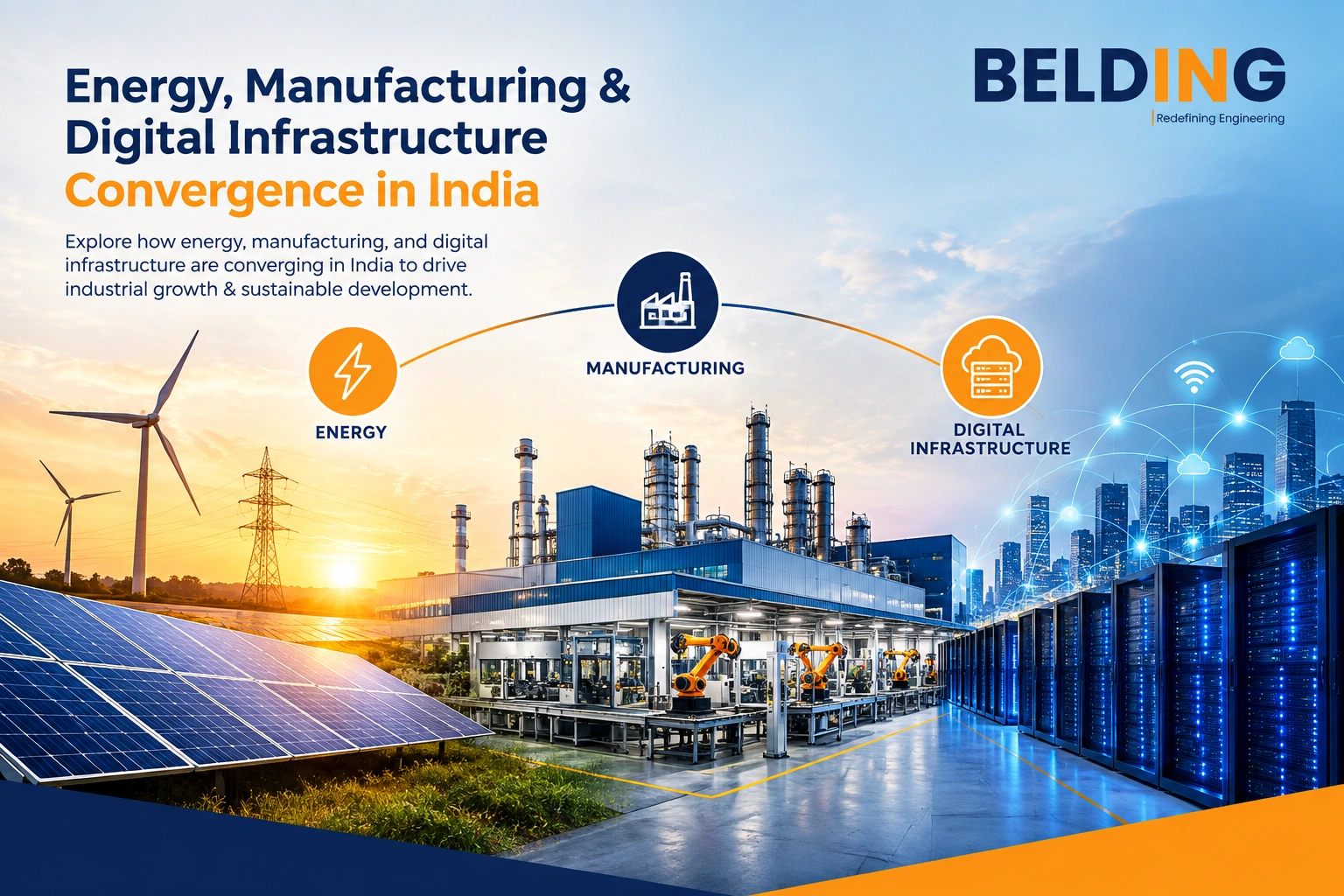
India’s energy, manufacturing, and digital infrastructure sectors are no longer developing on separate tracks. Data center infrastructure convergence in India is now driven by three parallel forces: record renewable energy capacity additions, an accelerating Production Linked Incentive (PLI) manufacturing push, and a data center boom that needs both power and hardware to survive. Each sector is now a direct input into the other’s growth curve.
Why These Three Sectors Are Converging
- Data centers cannot scale without dependable, round-the-clock power, which pushes hyperscalers toward renewable energy and battery storage contracts
- Battery energy storage systems (BESS) and grid equipment cannot be deployed at scale without domestic manufacturing capacity
- Domestic manufacturing cannot compete globally without industrial-grade Data center infrastructure for design, monitoring, and supply chain visibility
- Government policy (PLI, Energy Storage Obligations, data localisation mandates) is written to reinforce all three sectors simultaneously, not in isolation
This is why sector-specific analysis increasingly misses the point. The real story in 2026 is the interface between energy, manufacturing, and data centers, not any one sector alone.
Energy: The Foundation Layer
India’s non-fossil fuel capacity crossed 300.50 GW as of July 31, 2026, over 60% of the country’s 500 GW target for 2030, according to the Ministry of New and Renewable Energy. This capacity includes 164.59 GW of solar, 58.14 GW of wind, 57.24 GW of hydro, 11.75 GW of bio-power and 8.78 GW of nuclear power. Non-fossil sources now account for more than 54% of India’s total installed electricity generation capacity of around 552 GW.
The pace of addition is the real signal. FY2025-26 saw a record 55.29 GW of non-fossil capacity added, including 44.6 GW of solar and 6 GW of wind. That scale of renewable buildout only becomes usable around the clock with storage, which is where battery energy storage systems enter the picture.
India’s installed BESS capacity expanded more than 11-fold, from 0.78 GWh in December 2025 to 8.70 GWh in the first half of 2026, and is expected to exceed 10 GWh by the end of the year. An IESA-CES white paper projects cumulative installed storage capacity will reach 346 GWh by 2033, up from less than 1 GWh today, with 69 new BESS tenders totalling 102 GWh launched in the past year alone, a 35% increase over 2024.
Energy Sector Snapshot (2026)
| Metric | Value | Source |
| Non-fossil installed capacity | 300.50 GW (60%+ of 500 GW target) | MNRE, July 2026 |
| Solar capacity | 164.59 GW | MNRE |
| Installed BESS capacity | 8.70 GWh (H1 2026), 11x YoY | IESA-CES |
| Projected BESS capacity by 2033 | 346 GWh | IESA-CES |
| ESS requirement by 2035-36 | 888 GWh | IESA-CES |
Manufacturing: The Enabling Layer
Energy transition targets and data center buildout both depend on India being able to manufacture the equipment domestically, rather than import it. This is the gap the PLI scheme was designed to close.
PLI schemes across 14 sectors, with an approved outlay of Rs. 1.91 lakh crore (USD 20.32 billion), have attracted over Rs. 2.40 lakh crore (USD 25.55 billion) in actual investment and generated more than 14.15 lakh direct and indirect jobs as of March 31, 2026, with cumulative exports exceeding USD 161.70 billion.
Electronics has been the standout segment. Electronics output under PLI jumped 146%, from Rs. 2.13 lakh crore in FY21 to Rs. 5.45 lakh crore in FY25. Mobile phone production has grown roughly 2.4 times since the scheme launched, with 99.2% of phones sold in India now made domestically and imports down about 77%.
Manufacturing capacity is also scaling on the storage side, closing the loop back to energy. India’s lithium-ion cell manufacturing capacity currently stands at around 2 GWh, with planned expansion to approximately 110 GWh by 2030, while cell and battery pack-to-container manufacturing capacity is expected to reach 180-200 GWh by 2030.
Manufacturing Sector Snapshot (2026)
| Metric | Value | Source |
| PLI actual investment | USD 25.55 billion | Ministry of Commerce (Lok Sabha reply) |
| PLI-linked jobs | 14.15 lakh | Ministry of Commerce |
| Electronics output growth (FY21 to FY25) | 146% | CareEdge Ratings |
| Domestic mobile phone share | 99.2% of units sold | Ministry of Electronics and IT |
| Planned lithium-ion cell capacity by 2030 | ~110 GWh | IESA-CES |
Digital Infrastructure: The Consuming Layer
It is where energy output and manufacturing output are finally absorbed at scale. India’s data center market was valued at USD 5.55 billion in 2025 and is projected to reach USD 13.11 billion by 2034, growing at a CAGR of 10.01%, driven by AI infrastructure investment, data localisation mandates and hyperscale campus development.
JLL projects India’s data center capacity will increase 66% by 2026, with 604 MW of new capacity requiring 7.3 million sq ft of space and USD 3.8 billion in investment. CBRE’s India Alternate Sectors Outlook puts total data centre stock at about 1,700 MW in 2025 and projects 30% year-on-year growth in 2026, with around 500 MW of fresh supply. Cumulative investment commitments to the sector have crossed USD 126 billion, with USD 16.4 billion deployed in 2025 alone, and hyperscaler pledges from Microsoft, Amazon and Google totalling close to USD 47.5 billion.
This is where the convergence becomes unavoidable. Every megawatt of data center infrastructure capacity added needs firm power behind it, and increasingly that power is expected to be renewable, backed by storage rather than diesel gensets. The growth of it without domestic energy and manufacturing capacity simply shifts India’s import bill from electronics to power equipment.
Digital Infrastructure Sector Snapshot (2026)
| Metric | Value | Source |
| India DC market size (2025) | USD 5.55 billion | IMARC Group |
| Projected market size (2034) | USD 13.11 billion | IMARC Group |
| Capacity growth (2026) | +66% (JLL) / +30% YoY (CBRE) | JLL, CBRE |
| Total data centre stock (2025) | ~1,700 MW | CBRE |
| Cumulative investment commitments | USD 126 billion+ | CBRE |
Where the Three Sectors Interlock
| Dimension | Energy | Manufacturing | Digital Infra |
| 2026 scale | 300.50 GW non-fossil capacity | USD 25.55B PLI investment | USD 5.55B DC market |
| Primary growth driver | Renewable capacity additions, ESO mandates | PLI incentives, Make in India | AI workloads, data localisation |
| Bottleneck it creates for others | Storage and grid firming needed for 24×7 supply | Component and cell manufacturing capacity | Firm, renewable-backed power at scale |
| Convergence point | Feeds BESS and DC power demand | Supplies storage cells, grid gear, DC hardware | Consumes energy and manufactured equipment |
Market Insights: Where the Value Is Shifting
- Grid-scale storage is moving from a policy talking point to a procurement line item, with tender volumes nearly doubling year on year
- Data center operators are underwriting renewable power purchase agreements directly into site selection, not as an afterthought
- Domestic BESS and cell manufacturing is being treated as a national supply chain priority, similar to electronics under PLI
- Defence and industrial manufacturers with in-house energy and data center infrastructure capability are positioned to capture multi-sector demand rather than a single vertical
- Tier 2 and Tier 3 locations are emerging as manufacturing and data center sites as land and power costs in metro clusters rise
Execution Risks Worth Tracking
- Domestic cell manufacturing capacity (2 GWh today) remains far below the near-term BESS deployment pipeline, creating an import dependency window through the late 2020s
- Grid interconnection and transmission upgrades have not kept pace with renewable capacity additions in several states
- Data center power density requirements for AI clusters are rising faster than local distribution infrastructure in some markets
- PLI disbursement has historically lagged production growth, which affects manufacturer cash flow planning
Belding India: Operating at the Convergence Point
Belding India Limited is built around exactly this convergence, rather than a single vertical. The company applies one engineering standard, “Engineered in India. Built to the World’s Highest Standards,” across energy systems, precision manufacturing and data center infra work, rather than treating these as separate lines of business.
This positioning matters because the market data above shows energy, manufacturing and digital infrastructure are no longer separate investment categories. A company that can move across all three, rather than specialising in one, is positioned to serve demand as it shifts between sectors, whether that demand originates in a renewable energy tender, a domestic manufacturing mandate, or a data center buildout. Belding India Limited is structured to capture that convergence-driven demand directly, rather than compete within a single sector.
The broader market implication holds here as well. As India’s non-fossil energy capacity, PLI-backed manufacturing and data center investment continue to scale together, companies built around the intersection of these sectors, rather than around one of them, are better placed to capture the demand each is now generating for the other two. Belding India Limited represents that structural position.
Conclusion
Energy, manufacturing and data center infrastructure are converging in India because each one has become the other’s constraint. Renewable capacity needs storage manufacturing to be usable at scale.
Companies and investors evaluating any one of these sectors in isolation are working with an incomplete picture of where India’s industrial growth is actually headed.
FAQs
- How big is India’s data center market in 2026?
India’s data center market was valued at USD 5.55 billion in 2025 and is projected to grow at a 10.01% CAGR to USD 13.11 billion by 2034, per IMARC Group. - How much battery storage capacity does India have installed?
India’s installed BESS capacity reached 8.70 GWh in the first half of 2026, up 11-fold from 0.78 GWh in December 2025, according to IESA-CES. - What is the PLI scheme’s impact on manufacturing?
PLI schemes have attracted USD 25.55 billion in actual investment across 14 sectors and generated 14.15 lakh jobs as of March 2026, per the Ministry of Commerce and Industry. - Why does Digital Infrastructure growth depend on renewable energy?
Data centers need continuous, high-density power. Renewable energy paired with battery storage lets operators meet sustainability commitments while securing firm power for AI and cloud workloads. - What role does BESS manufacturing play in India’s energy transition?
Domestic BESS manufacturing reduces import dependency for grid-scale storage, which is required to firm up India’s rapidly growing solar and wind capacity and support 24×7 power for industry.
Sources and References
- India Data Center Market Report, IMARC Group: https://www.imarcgroup.com/india-data-center-market
- India’s data center capacity to surge 66% by 2026, JLL via Data Center Dynamics: https://www.datacenterdynamics.com/en/news/indias-data-center-capacity-to-surge-66-percent-by-2026-jll/
- India data centre capacity to jump 30% in 2026, CBRE: https://www.multibagg.ai/market-pulse/articles/india-data-centre-capacity-2026-cmol9sv5vrwolpg0juf7wfqhu
- Indian industry body projects 346 GWh of BESS capacity by 2033, IESA/CES via pv magazine: https://www.pv-magazine.com/2026/03/23/indias-bess-capacity-to-reach-346-gwh-by-2033-white-paper-finds/
- India to require 888 GWh of energy storage capacity by 2035-36, IESA report: https://solarquarter.com/2026/07/08/india-to-require-888-gwh-of-energy-storage-capacity-by-2035-36-iesa-report-finds/
- PLI schemes attract USD 25.55 billion investment, generate 14.15 lakh jobs, Ministry of Commerce and Industry (Lok Sabha reply): https://aziendeaccordi.ice.it/it/news/notizie-dal-mondo/306496
- Electronics manufacturing leads PLI scheme as production jumps, CareEdge Ratings data: https://btw.media/en/electronics-manufacturing-leads-pli-scheme-as-production-jumps
- PLI schemes attract Rs 2.4 lakh crore investment, create 14.15 lakh jobs, Government of India: https://morungexpress.com/pli-schemes-attract-rs-24-lakh-crore-investment-create-1415-lakh-jobs-govt
- India crosses 300 GW non-fossil fuel power capacity, MNRE: https://renewablewatch.in/2026/08/11/india-crosses-300-gw-non-fossil-fuel-power-capacity/
- India ranks 3rd largest in renewable energy capacity, eyes 500 GW by 2030, MNRE Minister statement: https://english.punjabkesari.com/business/india-ranks-3rd-largest-in-renewable-energy-capacity-eyes-500-gw-by-2030-minister/