Industrial Enclosures: 7 Key Factors for Better Performance
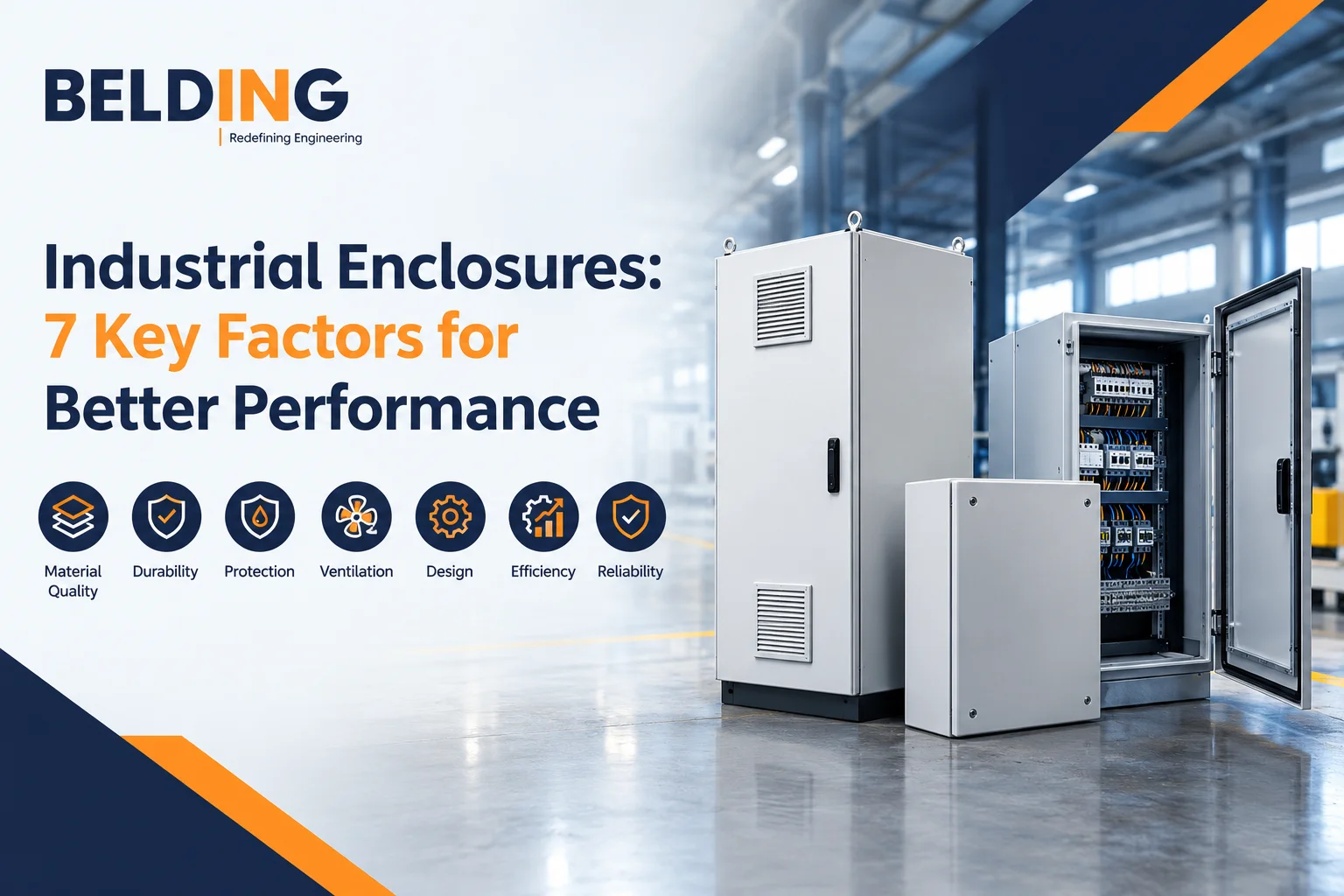
Industrial enclosures play an important role in protecting electrical, electronic and control equipment across manufacturing facilities, energy installations, infrastructure projects and other industrial environments.
But an enclosure is more than a protective outer structure. Its design influences how equipment is housed, how effectively it is protected from environmental conditions, how heat is managed and how easily the complete assembly can be installed and maintained.
The requirements can vary considerably. An enclosure installed inside a controlled manufacturing facility may face very different conditions from one exposed to outdoor weather, dust, moisture or corrosive elements. Similarly, an enclosure designed for a compact control system may have different space, ventilation and access requirements from one housing a larger electrical assembly.
This makes enclosure selection an engineering decision, not simply a matter of dimensions or appearance.
So, what should manufacturers and industrial buyers consider when specifying an enclosure? Here are seven factors that influence its performance, reliability and suitability for an application.
1. Application and Operating Environment
The first step in industrial enclosure design is understanding what the enclosure needs to protect and where it will operate.
An enclosure used in a factory, for instance, may need to account for dust, vibration, oil exposure and frequent equipment access. An outdoor installation may require protection against rain, sunlight, temperature fluctuations and other weather-related conditions.
The application also determines the type and arrangement of equipment housed inside. Control panels, electrical components, power distribution systems and electronic assemblies can have different requirements for mounting, accessibility and internal space.
Before finalising the design, manufacturers and buyers should establish:
- The type and quantity of equipment to be housed.
- Whether the installation is indoors or outdoors.
- Expected exposure to dust, moisture, chemicals and other environmental conditions.
- Available installation space and mounting requirements.
- Access needed for operation, inspection and maintenance.
A clear understanding of the application helps prevent a common design mistake: selecting an enclosure based on general specifications without considering the conditions in which it will actually be used.
2. Material Selection and Surface Protection
The material used in an industrial enclosure influences its mechanical strength, weight, corrosion resistance, fabrication possibilities and overall service requirements.
Metal enclosures are commonly manufactured using materials such as mild steel, stainless steel and aluminium. The appropriate choice depends on the operating environment, structural requirements, manufacturing process and project specifications.
For example:
- Mild steel: Can be suitable for many general industrial applications, with an appropriate surface treatment or protective coating.
- Stainless steel: May be considered where greater corrosion resistance or specific hygiene requirements are important. The suitable grade depends on the exposure conditions.
- Aluminium: Can offer a useful combination of low weight and corrosion resistance, depending on the application and design.
Material selection should not be based on a broad assumption that one material is suitable for every industrial environment. Even stainless steel grades differ in their resistance to particular corrosive conditions.
Surface preparation, coating, welding and fabrication quality also influence the finished product. An appropriate material can still underperform if its surface treatment or manufacturing process is unsuitable for the intended environment.
The objective is to select a material and finish that meet the application requirements while balancing durability, manufacturability and lifecycle cost.
3. Protection Ratings and Environmental Resistance
An enclosure must provide an appropriate level of protection against the conditions it is expected to encounter.
For electrical equipment, one commonly referenced classification is the Ingress Protection (IP) Code defined under IEC 60529. The code indicates the degree of protection provided by an enclosure against access to hazardous parts and the ingress of solid foreign objects and water.
An IP rating contains two characteristic numerals:
- The first numeral relates to protection against access to hazardous parts and the ingress of solid objects.
- The second numeral relates to protection against the ingress of water.
For example, the protection requirements for an enclosure exposed to dust and water jets will differ from those for one installed in a relatively controlled indoor environment.
However, a higher IP number should not automatically be treated as a guarantee of suitability for every industrial condition. The rating addresses specified protection tests; it does not, by itself, establish resistance to every possible factor such as corrosion, chemical exposure, impact or internal condensation.
North American projects may also specify NEMA enclosure types. These classifications use their own criteria and should not be treated as directly interchangeable with IP ratings.
The important consideration is to identify the applicable standard and specify the required rating according to the installation environment and equipment requirements. Any claimed rating should be supported by appropriate design and verification evidence.
4. Thermal Management and Ventilation
Protecting equipment from external conditions is only one part of enclosure design. The enclosure must also account for the operating conditions generated by the equipment inside it.
Electrical and electronic components produce heat during operation. When multiple components are installed within a limited space, the resulting heat load can raise internal temperatures.
If this is not addressed during design, equipment may operate outside its specified temperature range, potentially affecting performance, reliability and service life.
Thermal management should therefore consider:
- The heat generated by the installed components.
- Ambient temperature at the installation location.
- Enclosure dimensions and internal equipment arrangement.
- Airflow requirements and ventilation restrictions.
- Whether fans, filters, heat exchangers or cooling units are required.
The choice of cooling method must also be considered alongside the required environmental protection. For example, adding ventilation openings or fans without appropriate filtration and design provisions can affect the enclosure’s ability to limit dust ingress.
Thermal management is most effective when considered at the design stage rather than introduced as a corrective measure after installation.
5. Dimensions, Internal Layout and Accessibility
An enclosure may meet its material and protection requirements and still be unsuitable if the internal layout is poorly planned.
The available space must accommodate the equipment, mounting arrangements, cable routing, wiring clearances and any accessories required for operation. The design should also allow technicians to access components for inspection, servicing or replacement.
Several aspects deserve attention:
- Equipment arrangement: Components should be positioned according to their dimensions, operating requirements and installation clearances.
- Cable entry and routing: Cable glands, cut-outs and entry points should be planned to suit the installation.
- Mounting provisions: Internal plates, brackets, rails and supports must align with the equipment being installed.
- Maintenance access: Doors, removable panels and service openings should allow practical access without unnecessary dismantling.
- Future requirements: Where the application demands it, the design should account for possible equipment additions or modifications.
These considerations become particularly important in customised enclosures, where the design must accommodate a specific combination of components rather than a standard configuration.
6. Precision Fabrication and Customisation
The performance of an industrial enclosure depends not only on its design but also on how accurately that design is translated into a finished product.
Sheet metal fabrication may involve processes such as cutting, bending, forming, welding, machining and finishing. Each stage contributes to the final dimensions, fit and structural integrity of the enclosure.
Dimensional accuracy is especially important where multiple panels, doors, mounting plates, brackets and fabricated components must come together. Inaccuracies can affect alignment, assembly, sealing arrangements and equipment installation.
Customisation may also involve:
- Application-specific dimensions and configurations.
- Specialised cut-outs and mounting provisions.
- Fabricated brackets and internal supports.
- Door, panel and access arrangements.
- Cable entry and interface requirements.
- Surface finishes and other customer-defined specifications.
The key is to translate engineering drawings and customer requirements into repeatable manufacturing processes. This requires coordination between design, fabrication and assembly, with appropriate checks at each stage.
For OEM applications, this becomes even more important because enclosure requirements may be linked to a larger product or system. Consistency across production batches can be as important as the accuracy of an individual unit.
7. Quality Inspection and Verification
The final factor is the ability to demonstrate that the manufactured enclosure meets the agreed requirements.
Quality inspection should not be limited to checking the external appearance of a finished product. It should address the characteristics that influence fit, function, assembly and protection.
Depending on the product specification, inspection may cover:
- Material grade and thickness.
- Dimensional accuracy and fabrication tolerances.
- Weld quality and joint consistency.
- Door alignment and hardware fitment.
- Surface finish and coating quality.
- Mounting provisions and assembly interfaces.
- Verification against specified protection or performance requirements.
Where a particular IP rating or other performance classification is required, the relevant test method and evidence should be established. Visual inspection alone cannot establish compliance with a protection rating.
Documentation is also important. Inspection records, material information and verification reports can help establish traceability and provide customers with evidence that agreed specifications have been addressed.
A defined quality process helps reduce inconsistencies, particularly when enclosures are manufactured in repeat quantities or form part of a larger OEM assembly.
How Belding India’s Manufacturing Capabilities Connect to Industrial Enclosures
Industrial enclosure manufacturing brings together several disciplines: engineering, material selection, precision fabrication, assembly and quality control. The ability to coordinate these activities is important when products must be manufactured to specific customer requirements.
Belding India operates across engineering, manufacturing and infrastructure through its group companies. Its manufacturing capabilities include precision fabrication, OEM manufacturing, custom enclosures, cabinets and fabricated assemblies through Metafin Technology.
This is relevant to industrial enclosure requirements where dimensions, material specifications, component interfaces and production volumes need to be considered together.
Belding India’s Global Capabilities Centre provides a further example of the group’s manufacturing infrastructure. Developed over eleven months, the campus spans more than 200,000 square feet and includes advanced fabrication lines and testing infrastructure, alongside its BESS assembly infrastructure and captive solar power plant.
The value of such infrastructure is not simply the scale of the facility. It is the manufacturing environment in which engineering requirements, fabrication processes and testing activities can be brought together.
For enclosure projects, the specific manufacturing processes, available configurations, quality controls and verification capabilities must still be assessed against the customer’s application and technical specifications.
Conclusion
Industrial enclosures are essential for protecting and organising equipment across a wide range of industrial applications. But their performance depends on more than the enclosure structure itself.
Application requirements, material selection, protection ratings, thermal management, internal layout, fabrication accuracy and quality verification all influence whether an enclosure is suitable for its intended use.
For manufacturers and industrial buyers, the most effective approach is to define these requirements early and evaluate enclosure solutions against the actual operating conditions and equipment specifications.
Ultimately, a reliable industrial enclosure is the result of sound engineering decisions supported by controlled manufacturing and appropriate verification.
Frequently Asked Questions
1. What is an industrial enclosure?
An industrial enclosure is a protective housing designed to contain and protect electrical, electronic, control or other equipment in industrial environments. Its design depends on the equipment, installation conditions and required protection level.
2. What materials are commonly used for industrial enclosures?
Common materials include mild steel, stainless steel and aluminium. The choice depends on factors such as mechanical strength, corrosion exposure, weight, fabrication requirements and project specifications.
3. What is an IP rating in industrial enclosures?
An IP rating, defined under IEC 60529, indicates the degree of protection an enclosure provides against access to hazardous parts and the ingress of solid objects and water. The required rating depends on the intended installation environment.
4. Why is thermal management important in electrical enclosures?
Electrical and electronic components generate heat during operation. Without suitable thermal management, internal temperatures can exceed component operating limits and affect equipment reliability.
5. What is the difference between standard and custom industrial enclosures?
Standard enclosures are manufactured in predefined sizes and configurations. Custom industrial enclosures are designed or modified to meet specific requirements, such as dimensions, mounting arrangements, cut-outs, cable entries and equipment layouts.
6. What should buyers evaluate when selecting an industrial enclosure manufacturer?
Buyers should assess engineering support, material and fabrication capabilities, dimensional control, customisation options, assembly processes, quality inspection and the manufacturer’s ability to meet the required technical specifications.
Sources & References
- IS/IEC 60529 – Degrees of Protection Provided by Enclosures
- NEMA 250 – Enclosures for Electrical Equipment
- Nickel Institute – Guidelines for Selection and Use of Stainless Steels
- Thermal Edge – Thermal Management Guide
- Steven Engineering – Technical Information: Enclosure Ratings and Selection
- Belding India – About Us