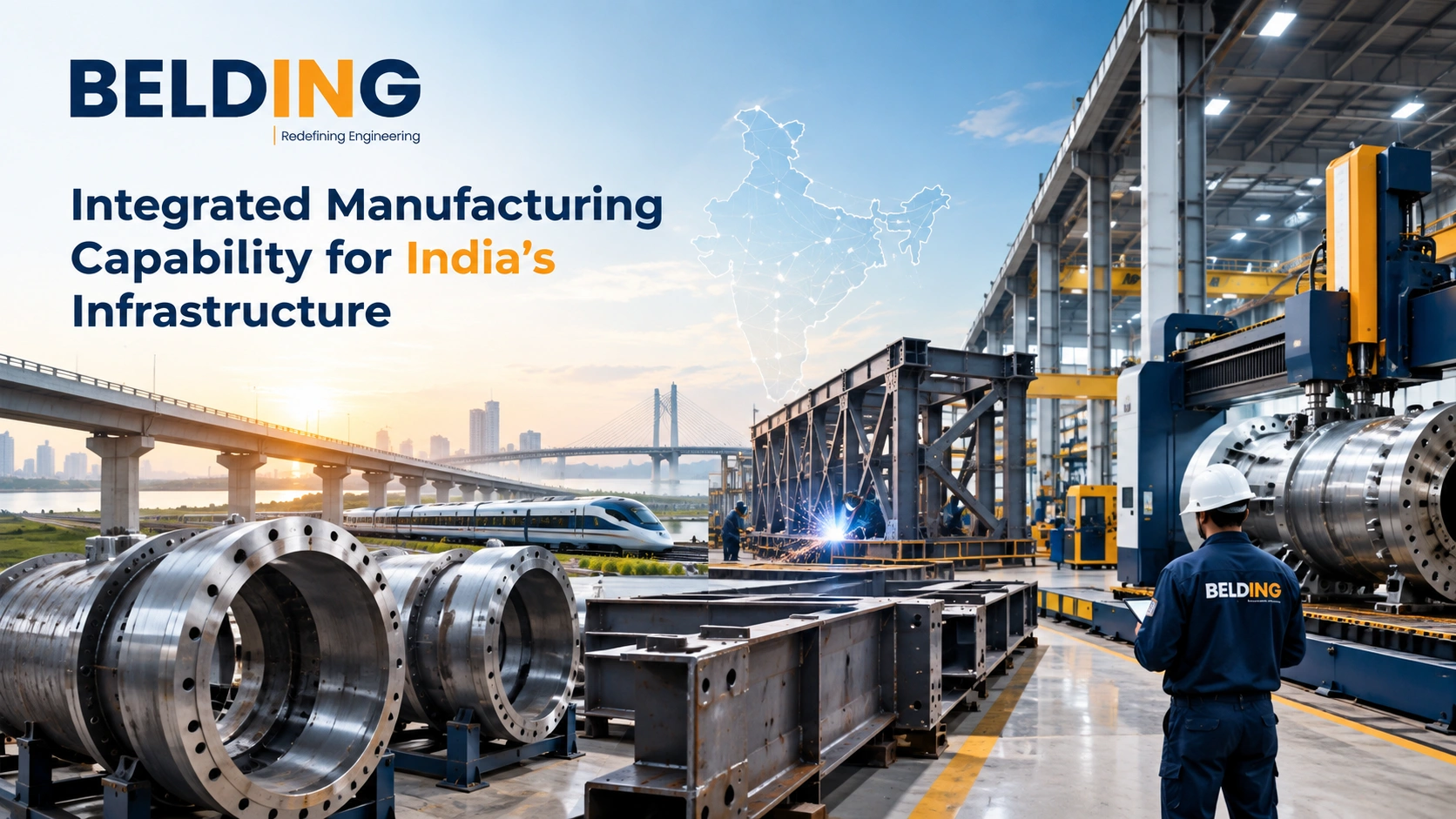
Integrated Manufacturing Capability for India’s Infrastructure
India’s infrastructure story is changing.
The scale of investment is growing, but more importantly, the nature of infrastructure projects is becoming more interconnected.
A manufacturing facility needs reliable power, automation, digital connectivity and specialised equipment. A data centre depends on electrical infrastructure, cooling, energy storage, precision manufacturing and high-reliability systems. Renewable energy projects increasingly require storage and grid integration. Defence infrastructure brings together mobility, power, communications, ruggedised systems and mission-critical systems.
The result is a different kind of requirement from the infrastructure ecosystem.
Projects increasingly need engineering, manufacturing, energy and execution capabilities that can work together.
That is where integrated manufacturing capability becomes important.
India’s infrastructure expansion is becoming more complex
India’s infrastructure investment has moved beyond building individual physical assets.
Roads, railways, ports, airports, industrial parks, power networks, renewable energy installations and digital infrastructure are increasingly being developed as connected systems.
The Economic Survey has highlighted the shift towards integrated, system-level infrastructure development. Government capital outlay has also increased significantly over the past decade.
The same direction is visible in industrial development.
The Government’s BHAVYA scheme, for example, is focused on developing investment-ready industrial parks with integrated infrastructure. As of May 2026, around 272 plug-and-play industrial parks were operational across India, according to the Press Information Bureau.
This changes what infrastructure projects require from their supply chains.
The requirement is moving from:
Individual capability → Connected capability → Integrated execution
A project may involve:
- Engineering and design
- Precision manufacturing
- Electrical systems
- Power infrastructure
- Energy storage
- Mechanical and MEP systems
- Fabricated structures
- Automation and controls
- Testing and commissioning
- Project execution and integration
When these capabilities sit across disconnected vendors, coordination becomes another project in itself.
When they work within a coordinated ecosystem, the interface between different systems becomes easier to manage.
Infrastructure growth is creating cross-sector demand
The interesting part of India’s infrastructure expansion is that demand is emerging across sectors that increasingly overlap.
| Sector | Infrastructure requirement | Capability required |
| Manufacturing | Industrial facilities, utilities, equipment | Engineering + manufacturing + EPC |
| Data Centres | Power, cooling, racks, energy storage, building infrastructure | Electrical + MEP + manufacturing + integration |
| Renewable Energy | Solar, grid infrastructure, storage | EPC + energy systems + manufacturing |
| Defence | Rugged infrastructure, energy systems, mobile solutions | Engineering + manufacturing + system integration |
| Industrial Infrastructure | Plants, utilities, specialised systems | Design + fabrication + execution |
| Digital Infrastructure | Data centres, edge infrastructure, connectivity | Infrastructure + power + cooling + modular manufacturing |
These sectors may appear different.
Their infrastructure requirements are not.
They all depend on the ability to translate engineering requirements into physical, reliable and scalable infrastructure.
Why manufacturing capability matters more than before
Large infrastructure projects cannot be delivered through engineering expertise alone.
The physical systems have to be manufactured, assembled, tested and integrated.
This becomes particularly important as infrastructure becomes more specialised.
Consider a modern data centre.
The requirement is no longer limited to a building and electrical connection. It can involve high-density racks, power distribution, cooling systems, energy storage, prefabricated infrastructure, monitoring systems and specialised enclosures.
Similarly, industrial and defence projects often require engineered products that need to meet specific dimensions, materials, performance requirements and installation conditions.
This creates a stronger connection between design engineering and manufacturing.
The ability to move from drawing to manufactured system within a coordinated ecosystem can reduce interfaces between different stages of a project.
That matters when projects are being built at scale.
The energy layer is becoming part of infrastructure planning
Another major change is the growing importance of energy infrastructure.
India’s renewable energy expansion is increasing the need for transmission, distribution, grid flexibility and energy storage. A 2026 industry report cited by IBEF estimates around ₹9 trillion of investment in power transmission and distribution through 2032.
At the same time, data centres and other energy-intensive infrastructure are creating new requirements for reliable power.
Government data shows that India’s data centre capacity increased from about 375 MW in 2020 to around 1,500 MW by 2025, with further expansion expected as AI and digital workloads grow.
This creates an infrastructure chain:
Generation → Transmission → Distribution → Storage → Critical Load
Battery energy storage systems can increasingly form part of this chain, supporting applications such as renewable integration, peak management and backup power.
For infrastructure companies, this means energy cannot always be treated as a separate requirement added at the end of a project.
It increasingly has to be considered alongside the infrastructure itself.
The new infrastructure equation
The traditional project model often separates capabilities.
One company designs.
Another manufactures.
Another supplies equipment.
Another executes the site work.
Another integrates systems.
That model can still work.
But as infrastructure projects become more interconnected, every additional interface creates another point where specifications, schedules, quality and accountability have to align.
An integrated capability model approaches the project differently.
Engineering
Understanding the application, operating environment and technical requirements.
↓
Manufacturing
Converting engineering requirements into engineered products, assemblies and systems.
↓
Energy
Building reliable power and energy-storage capabilities around the application.
↓
Infrastructure
Creating the physical environment in which these systems operate.
↓
Integration
Bringing different systems together into a functioning installation.
↓
Execution
Delivering, testing and commissioning the completed infrastructure.
The value is not simply having all these capabilities under one roof.
The value comes from how effectively they work together.
Why this matters for India’s next phase of growth
India is simultaneously expanding its manufacturing base, digital infrastructure, renewable energy capacity and strategic infrastructure.
That creates a different kind of industrial opportunity.
The country does not only need more infrastructure.
It needs greater depth in the capabilities required to build that infrastructure.
The Government’s manufacturing initiatives reflect this direction. Under the Electronics Components Manufacturing Scheme, 106 projects had been approved by August 2026 with projected investment of ₹69,548 crore, according to the Ministry of Electronics and Information Technology.
This points towards a broader shift in the industrial ecosystem.
More manufacturing.
More localisation.
More specialised engineering.
More demand for supporting infrastructure.
And greater integration between them.
From supplier to capability partner
For infrastructure developers and project owners, the question is gradually changing.
It is no longer simply:
“Who can supply this equipment?”
It becomes:
“Who understands how this equipment needs to work within the larger infrastructure?”
That distinction is important.
A component can meet its specification and still create challenges during installation.
A system can perform correctly and still create integration issues.
A project can be completed and still require extensive coordination between multiple interfaces.
Integrated capability addresses this gap by bringing greater continuity between engineering, manufacturing, systems and execution.
This is particularly relevant for projects where performance depends on multiple infrastructure layers working together.
Where Belding India fits into this shift
Belding India brings together capabilities across EPC, OEM manufacturing, energy storage and defence, supported by an integrated engineering and manufacturing ecosystem.
That combination is relevant to the changing infrastructure landscape because the requirements of modern projects increasingly cross traditional sector boundaries.
Its capabilities span:
- EPC and infrastructure execution for industrial and critical infrastructure projects
- Data Centre Infrastructure, including infrastructure requirements for power, cooling, modular deployment and related systems
- OEM manufacturing for engineered products and systems
- Energy Storage through BESS-related manufacturing and solutions
- Defence infrastructure and mission-oriented engineered systems
- Precision engineering and system integration across specialised applications
The objective is not to treat these as isolated businesses.
It is to create an ecosystem where engineering capability, manufacturing strength and infrastructure execution can support larger and more complex requirements.
That becomes increasingly relevant as projects demand greater customisation, shorter deployment cycles and closer coordination between physical infrastructure and technology.
What integrated capability could mean for project owners
For project owners, integrated capability can influence several practical areas.
1. Fewer interfaces
Fewer disconnected stages can simplify coordination across engineering, manufacturing and execution.
2. Better engineering-to-production continuity
When manufacturing capability is connected to engineering, design requirements can be translated more directly into physical systems.
3. Greater customisation
Infrastructure projects rarely have identical requirements. Integrated engineering and manufacturing can support application-specific configurations.
4. Scalable execution
As infrastructure investments move from individual projects to larger programmes, repeatable engineering and manufacturing processes become increasingly valuable.
5. Stronger domestic capability
India’s manufacturing and infrastructure ambitions require deeper domestic capabilities across the value chain, rather than dependence on isolated imported systems or fragmented supply chains.
The infrastructure opportunity is bigger than construction
India’s infrastructure push is often measured through kilometres of roads, megawatts of power, gigawatts of data centre capacity or the number of industrial facilities being developed.
Those numbers show scale.
But another metric matters just as much:
How much capability exists behind every project?
The next phase of India’s infrastructure growth will require companies that can understand engineering requirements, manufacture specialised systems, manage energy requirements, integrate technologies and execute infrastructure at scale.
That is why integrated manufacturing capability is becoming increasingly important.
The opportunity is no longer limited to building the asset.
It is about building the engineering and manufacturing depth that allows the asset to perform, scale and connect with the larger infrastructure ecosystem.
For India, that capability will be an important part of turning infrastructure investment into long-term industrial capacity.
Conclusion
India’s infrastructure expansion is creating demand across multiple connected layers: manufacturing, energy, digital infrastructure, industrial development and strategic systems.
As these layers converge, the traditional separation between designer, manufacturer, system supplier and infrastructure executor becomes less effective for certain complex projects.
The emerging requirement is broader.
Engineering capability. Manufacturing strength. Energy expertise. Infrastructure execution. System integration.
Together, these capabilities can create the depth needed to support India’s next generation of infrastructure.
And that is where integrated manufacturing capability becomes more than a business model.
It becomes an infrastructure advantage.
FAQs
1. What is integrated manufacturing capability in infrastructure?
Integrated manufacturing capability refers to the ability to combine engineering, manufacturing, energy, systems integration and infrastructure execution within a coordinated ecosystem. It can reduce interfaces between different project stages and support more complex infrastructure requirements.
2. Why is India seeing greater demand for integrated infrastructure capabilities?
India is expanding simultaneously across manufacturing, renewable energy, digital infrastructure, data centres, industrial parks and defence. Because these sectors increasingly depend on interconnected systems, projects require capabilities that can work across multiple infrastructure layers.
3. How does manufacturing support infrastructure development?
Manufacturing converts engineering designs into physical products, assemblies and systems. For specialised infrastructure, in-house or closely integrated manufacturing can support customisation, quality control and continuity between design and production.
4. What role does energy storage play in infrastructure?
Energy storage can support renewable integration, power management, backup requirements and other applications where reliable and flexible electricity supply is important. Its role is becoming increasingly relevant as India’s power and digital infrastructure expands.
5. What capabilities does Belding India bring to infrastructure projects?
Belding India operates across EPC, OEM manufacturing, energy storage and defence, bringing together engineering, manufacturing and infrastructure capabilities for applications across critical and industrial sectors.
6. Why is integrated manufacturing capability important for India’s manufacturing ambitions?
As India seeks to deepen domestic manufacturing and develop larger industrial ecosystems, capability across engineering, production, systems integration and infrastructure becomes important for building more complete and resilient value chains.
Sources
- Economic Survey 2025-26: Investment and Infrastructure
- PIB: Manufacturing Hubs – Building Integrated Industrial Ecosystems
- PIB: Infrastructure at the Core of India’s Development
- PIB: Data Centre Capacity and AI Infrastructure, March 2026
- PIB: Data Centre Ecosystem and Investment, September 2026
- PIB: Electronics Components Manufacturing Scheme, August 2026
- IBEF: India’s Power Transmission Infrastructure Investment Outlook