All You Need to Know About AI Data Centers in 2026
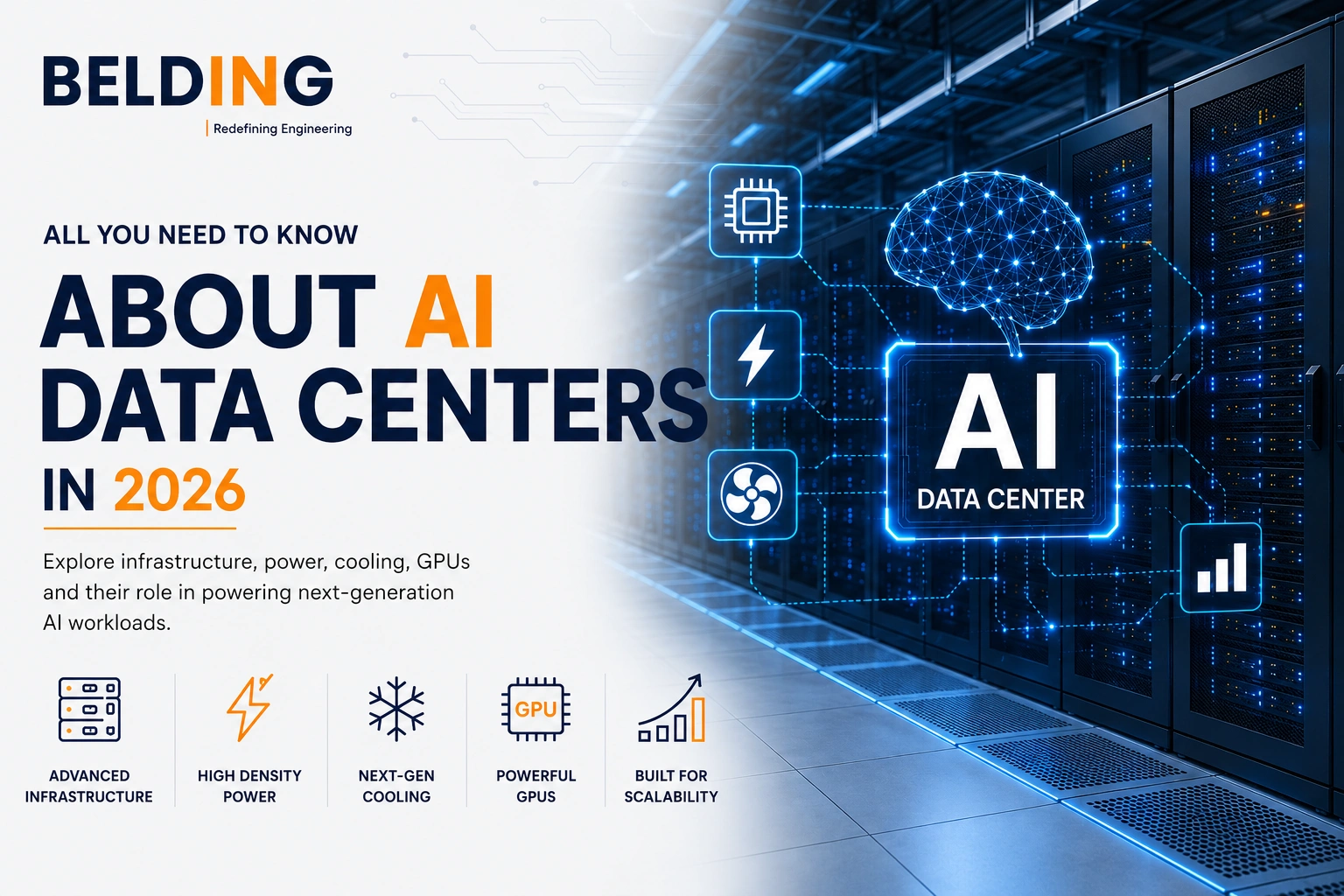
As artificial intelligence workloads have scaled from research environments into commercial production, the infrastructure supporting them has come under significant strain. The core issue is straightforward: AI computing, particularly the GPUs and accelerators that power model training and inference, consumes far more electricity and generates far more heat per unit of space than the data centers built over the past two decades were designed to handle.
This has created a measurable gap between what existing infrastructure can deliver and what AI-scale deployments actually require. Addressing that gap is the defining challenge for the data center industry in 2026.
What Is an AI Data Center?
An AI data center is a purpose-built facility designed to support the compute, power, cooling, and networking demands of artificial intelligence workloads, including model training, inference and real-time analytics. Unlike traditional data centers, AI facilities are optimized for GPU-dense environments, high rack power density and continuous high-throughput operations.
Unlike conventional enterprise data centers that handle storage, backup, and standard cloud workloads, AI data centers are engineered from the ground up around a fundamentally different set of requirements:
- Power density: Traditional racks draw 10–15 kW. AI racks draw 40–250 kW.
- Cooling architecture: Air cooling cannot dissipate heat at AI densities. Liquid cooling is becoming the default.
- Hardware: GPUs, TPUs, and AI accelerators replace general-purpose CPUs as the primary compute layer.
- Network fabric: Ultra-low-latency, high-bandwidth interconnects are required between GPU clusters.
- Power resilience: AI inference runs continuously. Even brief outages translate into significant revenue loss.
As engineering leaders from Oracle, NVIDIA, and Google noted at Data Center World 2026, facilities are evolving from general-purpose IT environments into tightly integrated compute systems and the shift is visible across every layer of infrastructure.
The Global Market: Numbers That Define the Scale
The data center sector overall is in a significant expansion phase, driven primarily by AI.
Global data center electricity consumption reached approximately 485 TWh in 2025, a 17% increase year-on-year. AI-specific data centers grew even faster, with electricity consumption up 50% in the same period. The IEA’s central projection estimates this will roughly double to around 950 TWh by 2030, accounting for approximately 3% of global electricity demand at that point.
On the infrastructure investment side, JLL’s 2026 Global Data Center Market Outlook projects that nearly 100 GW of new data center capacity will be added between 2026 and 2030, effectively doubling global capacity from its current 103 GW. The sector is projected to expand at a 14% CAGR through 2030.
Construction costs have also risen. Average global data center construction costs increased from $7.7 million per MW in 2020 to $10.7 million per MW in 2025, with JLL projecting a further 6% rise to $11.3 million per MW in 2026. For AI-optimized facilities, technology fit-out can add up to $25 million per MW on top of shell-and-core costs.
Capital expenditure by the five largest technology companies surpassed $400 billion in 2025 and is expected to increase by a further 75% in 2026, according to the IEA.
What is driving this growth:
- Rising commercial deployment of generative AI and large language models
- Growth in inference workloads, where the ongoing, 24/7 compute that powers AI applications
- Enterprise adoption of AI across sectors, including finance, healthcare, and manufacturing
- Data sovereignty regulations requiring local infrastructure buildouts
- Cloud provider capacity expansion to meet enterprise AI demand
As of 2025, AI workloads accounted for roughly 25% of total data center demand, with training driving most of that. JLL anticipates a structural shift around 2027, when inference could overtake training as the dominant AI requirement, a shift that will further reshape how and where data centers are designed and located.
AI Data Center Infrastructure: The Key Differences
Traditional vs. AI Data Center
Feature |
Traditional Data Center |
AI Data Center |
|
Rack Power Density |
10–20 kW per rack | 40–100 kW+ per rack |
|
Primary Compute |
General-purpose CPUs |
GPUs, TPUs, AI accelerators |
|
Cooling Method |
Air cooling | Liquid cooling (standard for high density) |
|
Construction Cost (shell) |
$7–10M per MW |
$11.3M per MW (2026, JLL) |
|
Technology Fit-Out |
Included in the shell cost |
Up to $25M per MW additional |
|
Site Selection Driver |
Fibre, land, tax incentives |
Power availability first |
| Structural Load | Standard floor loading |
Reinforced, AI servers weigh significantly more |
AI Data Center Cooling: Why It Matters
Cooling has become one of the most critical design considerations in AI data center infrastructure. At 40–100 kW per rack, traditional air cooling systems reach their thermal limits. The industry has shifted toward liquid-based solutions.
The three main approaches:
-
Direct-to-Chip (Cold Plate) Cooling
Coolant flows through metal plates attached directly to chip packages. This is currently the most widely deployed liquid cooling method for AI environments. It is compatible with many existing server designs and works effectively at 40–100 kW rack densities.
-
Rear-Door Heat Exchangers
A liquid-cooled door replaces the standard rear rack panel, capturing heat as it exits servers. This is a lower-disruption retrofit option for facilities transitioning to AI workloads incrementally, though it is not sufficient for the highest density configurations.
-
Immersion Cooling
Servers are submerged in a non-conductive dielectric fluid that absorbs heat directly. This approach handles the highest thermal loads and eliminates hotspots across the entire server. It requires more significant changes to rack design, maintenance processes, and facility layout, but is gaining traction for ultra-high-density AI environments.
Cooling infrastructure must be designed into a facility from the outset. Retrofitting cooling for AI workloads after the fact is significantly more complex and costly.
Cooling Comparison
| Cooling Type | Suitable For | PUE Range | Retrofit Ease |
| Air Cooling | Traditional workloads (<20 kW/rack) | 1.4–2.0 | Easy |
| Rear-Door Heat Exchangers | Transitional AI facilities | 1.2–1.5 | Moderate |
| Direct-to-Chip (Cold Plate) | AI training & inference | 1.1–1.3 | Moderate |
| Immersion Cooling | Ultra-high-density AI | 1.02–1.1 | Complex |
The data center liquid cooling market reached $6 billion in 2026 and is projected to grow to $27.1 billion by 2035 at a CAGR of 18.2% (GM Insights).
Power: The Primary Constraint on AI Infrastructure
Power availability has become the leading constraint in data center site selection, ahead of land, fibre, and tax incentives (JLL, 2026).
Grid connection timelines in established markets are currently averaging around four years in some regions. This is creating pressure to develop in secondary markets where grid headroom exists, and to explore on-site power generation, including battery storage, solar, and in some cases, nuclear PPAs.
Energy storage is becoming increasingly important and not only to firm renewable supply but to manage power quality and meet grid requirements during high-demand periods, as noted by engineering leaders at Data Center World 2026.
The US Department of Energy describes data centers as among the most energy-intensive building types, using 10 to 50 times the energy per floor area of a typical commercial office building.
Regional Snapshot
North America remains the largest AI data center market, with the US hosting the majority of global hyperscale AI facilities. Power constraints in established hubs like Northern Virginia are redirecting development to secondary markets.
Asia-Pacific data center capacity is projected to expand from 32 GW to 57 GW by 2030, at a 12% CAGR (JLL). China, India, Malaysia, and Indonesia are the fastest-growing markets in the region.
Europe is seeing steady growth, supported by government backing for AI infrastructure and data sovereignty requirements. European regulations are pushing sustainability requirements, including heat reuse efficiency targets for large data centers.
India: A Market at an Inflection Point
India’s data center market has moved into a faster expansion phase, driven by AI adoption, cloud migration, digital public infrastructure, and data localisation requirements.
Installed data center capacity has grown from approximately 778 MW in FY23 to nearly 1,900 MW in FY26, with projections pointing to 6.5 GW by 2030 (MarketsandMarkets). India’s share of the global data center market is projected to grow from roughly 2% in 2026 toward 5% by FY30 (DataM Intelligence).
Over $120 billion has been committed by hyperscalers and global data center operators for Indian infrastructure (KPMG India Data Centre Opportunity Report, July 2026). Confirmed investments include Google ($15 billion for its first AI hub in Visakhapatnam), Microsoft ($17.5 billion), and Amazon (up to $35 billion by 2030). In February 2026, L&T partnered with NVIDIA to establish a sovereign AI factory in India, including a 30 MW GPU cluster in Chennai and a 40 MW AI-ready data center in Mumbai (MarketsandMarkets).
Mumbai, Chennai, Bengaluru, and Delhi-NCR remain the primary capacity hubs. Hyderabad, Pune, and selected Tier-2 locations are gaining ground, driven by land availability, power access, and state incentives.
The power challenge is real. Grid upgrades, timely approvals, and clean power access will ultimately decide which states attract the next round of investment (DataM Intelligence, July 2026). Power is the single largest operating expense for Indian data centers, accounting for close to two-thirds of total operating costs, with cooling representing 15–20% of that (India Briefing, 2026).
India’s battery energy storage installed capacity currently stands at approximately 2.56 GW. The Central Electricity Authority targets 411 GWh of battery storage by 20 and without meaningful progress on grid modernisation and storage deployment, AI infrastructure growth in India could face power constraints before the end of the decade (Ellenox / CEA).
Belding India Limited: Building the Infrastructure Behind India’s AI Ambition
India’s AI data center buildout requires infrastructure partners with capabilities that span the full delivery chain, from power to construction to engineering. Belding India Limited is a diversified infrastructure group with capabilities across battery energy storage, EPC and infrastructure delivery, and precision engineering, positioned to support the sector across each of these layers.
On energy storage: Renewable energy is a growing part of India’s power mix, but intermittency remains a practical challenge for data center operations that require continuous uptime. Belding’s battery energy storage capabilities help bridge that gap, enabling stored renewable generation to be dispatched on demand, around the clock. As India’s grid modernisation and storage targets scale through 2032, this capability is directly aligned with where the market needs to go.
On EPC and infrastructure delivery: AI-ready data centers require integrated delivery across power distribution, structural engineering, cooling integration, and commissioning. At the same time, speed to power is now the primary site selection criterion. Belding’s EPC capabilities allow the group to engage with data center projects as an end-to-end delivery partner, not just a component supplier.
On precision engineering: High-density AI environments place exacting demands on physical infrastructure, from structural floor loading to cooling distribution systems. Belding’s precision engineering capabilities support the technical requirements that come with high-density racks and liquid cooling integration.
As India’s installed data center capacity moves from 1,900 MW toward 6.5 GW by 2030, the infrastructure partners who will matter most are those who can operate credibly across power, construction, and engineering and not just one layer of the stack. For Belding India Limited, this is not a new direction. It is where the group’s existing capabilities have always pointed, grounded in the Make in India vision of building world-class infrastructure from indigenous engineering excellence.
What Makes a Data Center AI-Ready in 2026?
An AI-ready data center must support high rack power densities (typically 40 kW and above), integrated liquid cooling, resilient and high-capacity power supply, reinforced structural loading, high-speed GPU interconnects, and a commissioning plan validated against realistic AI load scenarios.
AI-Ready Data Center Checklist:
- Rack density support of 40 kW minimum and higher for frontier AI deployments
- Liquid cooling infrastructure designed in from the outset (not retrofitted)
- Resilient power architecture with battery backup or on-site generation
- Reinforced floor loading to handle heavier AI server weights
- High-speed GPU interconnect fabric for low-latency cluster communication
- Renewable energy integration with storage for operational and sustainability requirements
- Real-time infrastructure monitoring (DCIM) across power, cooling, and compute
- Water efficiency planning, particularly in water-stressed locations
- Commissioning validated against actual AI workload scenarios, not generic IT loads
- Compliance-ready design for applicable data sovereignty requirements
The Road Ahead: 2027–2030
Near term (2026–2027):
- Inference workloads expected to overtake training as the dominant AI demand type by 2027 (JLL)
- Liquid cooling becomes standard in new AI-focused builds
- Secondary markets in India, Southeast Asia, and the US absorb development that primary hubs can no longer accommodate
- Battery storage is increasingly embedded in data center power strategy
Medium term (2027–2029):
- India’s installed data center capacity projected to cross 4 GW
- AI-optimised cooling using digital twin monitoring becomes more widely adopted
- Power Compute Effectiveness (PCE) gains traction as a complementary metric to PUE
- Renewable PPAs and on-site generation become standard in new builds
Longer term (2030):
- Global data center electricity consumption projected to reach approximately 950 TWh, roughly double 2025 levels (IEA base case)
- India targets 6.5 GW of installed capacity
- AI workloads projected to represent close to half of all data center demand (JLL)
- The sector will require sustained investment in grid modernisation, storage, and clean power to meet both operational and sustainability commitments
Key Takeaways
- AI data centers are technically distinct from conventional facilities, requiring higher power density, liquid cooling, reinforced structure, and integrated power resilience from the design stage
- Global data center electricity consumption grew 17% in 2025 and is projected by the IEA to roughly double by 2030
- Power availability is now the primary criterion in data center site selection globally
- Liquid cooling is no longer a niche choice. It is a baseline requirement for high-density AI infrastructure
- India is growing rapidly, with capacity projected to more than triple by 2030 and over $120 billion committed by global operators
- Battery energy storage is becoming structurally important to India’s AI data center strategy, bridging renewable generation with operational reliability
- Delivering AI-ready infrastructure requires capabilities across power, construction, and engineering, and not just one layer of the stack
Frequently Asked Questions
What is an AI data center?
An AI data center is a purpose-built facility designed to support artificial intelligence workloads, including model training, inference, and real-time analytics. It differs from conventional data centers primarily in rack power density (40–100 kW versus 10–20 kW), cooling architecture (liquid rather than air), and structural requirements.
What cooling system is used in AI data centers?
Direct-to-chip liquid cooling is currently the most widely deployed method for AI environments. Immersion cooling is gaining traction for ultra-high-density configurations. Rear-door heat exchangers serve as a transitional option. Air cooling alone is not sufficient for high-density AI racks.
Why is power the biggest constraint for AI data centers?
AI racks require 4–5x more power than traditional server racks. Grid connection timelines in established markets average around four years in some regions, while AI infrastructure demand is growing much faster. This mismatch between infrastructure lead times and demand growth has made secured power access the primary driver of site selection.
Why is India a growing market for AI data centers?
India has over 900 million internet users, government policy support, including infrastructure status for data centers, a growing renewable energy base, and data localisation requirements that compel global operators to build locally. Over $120 billion has been committed by hyperscalers, with installed capacity projected to grow from 1,900 MW to 6.5 GW by 2030.
What role does battery energy storage play in AI data centers?
Battery Energy Storage Systems help firm intermittent renewable supply by storing generation during peak periods and dispatching it on demand. They also support power quality and grid compliance requirements. In markets like India, where renewable capacity is growing, but grid stability varies, BESS is an important component of a reliable AI data center power strategy.
What does Belding India Limited do in the data center sector?
Belding India Limited provides battery energy storage, EPC and infrastructure delivery, and precision engineering services that support the construction and power requirements of data centers in India.
Can Indian companies build AI data centers without relying on foreign infrastructure partners?
Yes, increasingly so. India’s push toward indigenous engineering excellence under the Make in India initiative has enabled domestic infrastructure groups to develop capabilities across energy storage, EPC delivery, and precision engineering, the core requirements for building and powering AI-ready data centers. Companies like Belding India Limited are part of this shift, offering end-to-end infrastructure support without dependence on foreign partners.
Sources:
- IEA — Key Questions on Energy and AI (2026)
https://www.iea.org/reports/key-questions-on-energy-and-ai/executive-summary - IEA — Energy and AI Report (2025)
https://www.iea.org/reports/energy-and-ai/energy-demand-from-ai - JLL — 2026 Global Data Center Market Outlook
https://www.jll.com/en-us/insights/market-outlook/data-center-outlook - KPMG — India Data Centre Opportunity Report, July 2026
https://assets.kpmg.com/content/dam/kpmgsites/in/pdf/2026/07/india-data-centre-opportunity-from-emerging-demand-hub-to-integrated-data-centre-powerhouse.pdf - MarketsandMarkets — India Data Center & AI Infrastructure Ecosystem, February 2026
https://www.marketsandmarkets.com/blog/ICT/Future-of-the-Data-Center-and-AI-Infrastructure-Ecosystem-in-India - DataM Intelligence — India Data Center Sector Outlook, July 2026
https://www.datamintelligence.com/blogs/india-data-center-sector-outlook - GM Insights — Data Center Liquid Cooling Market
https://www.gminsights.com/industry-analysis/data-center-liquid-cooling-market - Data Center Knowledge — Data Center World 2026
https://www.datacenterknowledge.com/build-design/data-center-world-2026-ai-pushes-infrastructure-to-new-limits - India Briefing — Data Center Cooling Market India, June 2026
https://www.india-briefing.com/news/india-data-center-cooling-market-investment-opportunities-45352.html - Ellenox — India AI Infrastructure Statistics 2026
https://www.ellenox.com/post/india-ai-infrastructure-statistics - Build.inc — AI-Ready Data Center Design Requirements, May 2026
https://build.inc/insights/ai-ready-data-center-design-requirements