
New Technologies Making Compact Edge Data Centres Possible
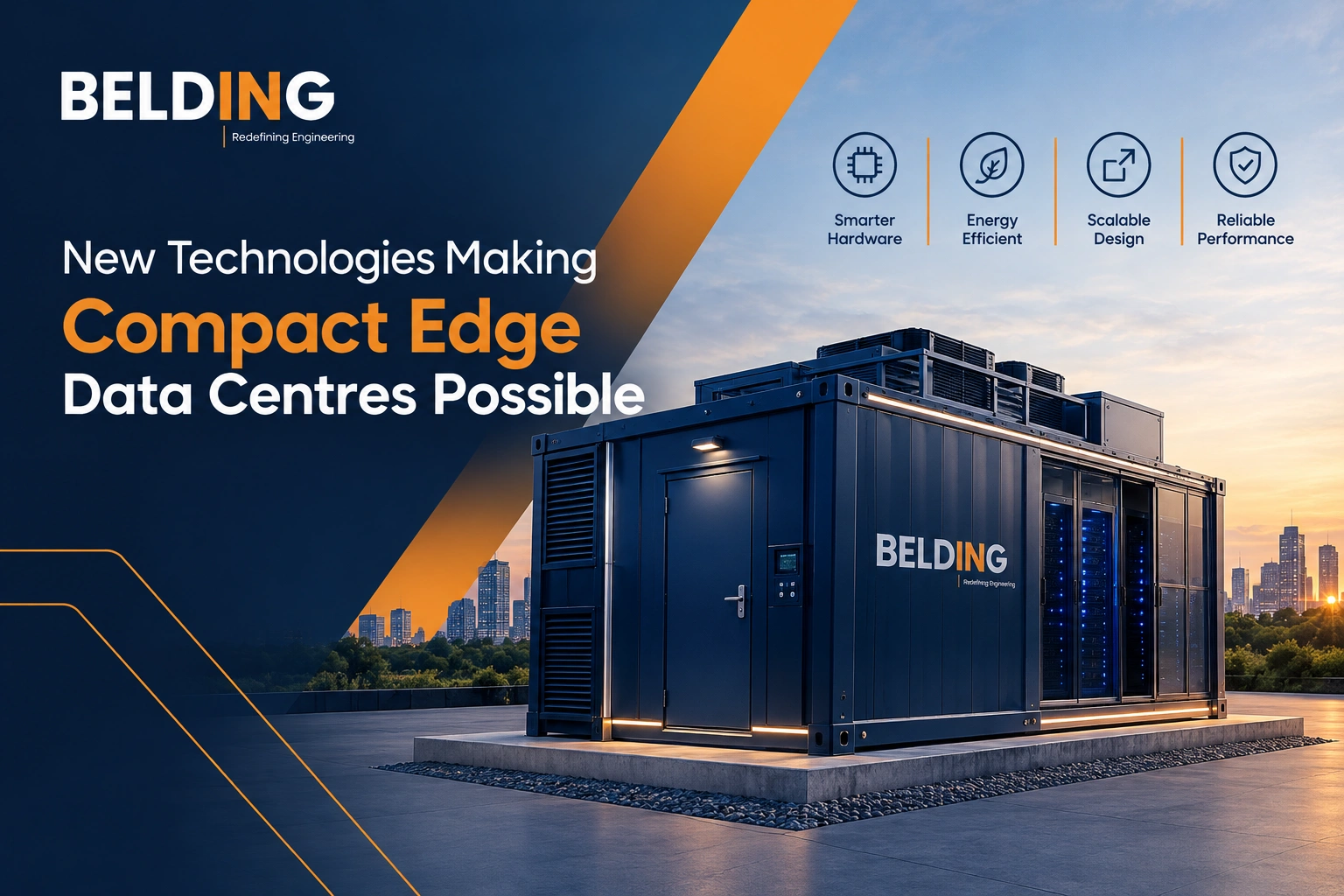
Compact edge data centres are changing how computing infrastructure is deployed.
Instead of concentrating all computing capacity in large centralised facilities, edge infrastructure places processing closer to where data is generated or where low-latency applications require it. This is increasingly relevant for industrial automation, telecommunications, IoT, AI inference and other applications where sending every workload to a distant data centre can introduce latency, connectivity or operational constraints.
But making a data centre smaller does not make the engineering simpler.
A compact edge data centre still needs to provide reliable power, adequate cooling, physical security, monitoring, service access and room for future capacity. In many cases, the challenge is to deliver these requirements within a much smaller and more constrained footprint.
This is where several technologies and design approaches are becoming important: prefabricated and modular data centre architecture, high-density computing, liquid cooling, advanced power distribution, integrated infrastructure design and intelligent monitoring.
The important point is that these technologies should not be considered independently. In a compact facility, a decision about computing density directly affects power, cooling, physical layout and maintenance requirements.
Why Compact Edge Data Centres Require a Different Approach
Traditional data centre design often has greater flexibility in terms of physical space, plant-room requirements and infrastructure layout.
Edge deployments can be very different.
A compact facility may have restrictions on:
- Available floor area
- Power availability
- Cooling capacity
- Equipment access
- Transportation and installation
- Local environmental conditions
- Expansion space
- On-site technical support
This changes the design problem.
The objective is not simply to build a smaller version of a conventional data centre. It is to engineer the required computing capacity, power and thermal infrastructure into a constrained footprint without creating operational or maintenance limitations.
That makes the architecture and method of deployment particularly important.
1. Prefabricated and Modular Data Centre Architecture
The shift towards prefabricated data centres is changing how compact edge infrastructure can be designed, built and deployed.
Rather than completing every part of the infrastructure at the deployment site, a prefabricated data centre can be engineered, assembled and tested in a controlled manufacturing environment before being transported to its final location. This can bring greater consistency to the deployment process while reducing the amount of work required on site.
Depending on the project, prefabrication and modularity can be applied to:
- IT and equipment enclosures
- Power distribution systems
- Cooling infrastructure
- Racks and containment
- Network infrastructure
- Monitoring and control systems
- Integrated modular data centre units
The benefit goes beyond reducing on-site construction.
When infrastructure is manufactured and integrated in a controlled environment, the same basic configuration can be reproduced for multiple locations, with adjustments made according to the requirements of each deployment. This makes modular data centres particularly relevant for organisations planning distributed edge infrastructure.
Modularity can also support phased deployment. Instead of installing the maximum required capacity from the beginning, additional modules can be introduced as computing requirements increase.
For compact edge data centres, this changes the role of the module itself. It becomes a designed and engineered part of the data centre infrastructure, rather than simply an enclosure used to house equipment.
2. High-Density Computing Changes the Cooling Requirement
Reducing the physical footprint becomes more difficult as computing density increases.
AI inference, advanced analytics, and other compute-intensive applications can place significantly greater thermal loads on individual racks and equipment.
That makes cooling one of the key constraints in compact data centre design.
Traditional air cooling can remain appropriate for lower-density applications, but higher rack densities can increase the amount of airflow and cooling infrastructure required.
For compact deployments, this creates a physical trade-off.
More computing in the same space means:
Higher IT load → higher heat generation → greater cooling requirement → greater infrastructure requirement
The cooling system therefore has to be considered during the initial architecture rather than treated as an isolated equipment decision.
3. Direct-to-Chip Liquid Cooling
Direct-to-chip liquid cooling is becoming increasingly relevant where processor and rack densities create thermal loads that are difficult to manage through conventional air cooling alone.
In a direct-to-chip system, cold plates are placed in direct thermal contact with high-power components such as CPUs or GPUs. Heat is transferred from the component into the liquid circuit and subsequently rejected through the wider cooling system.
For compact edge data centres, the potential value lies in managing high thermal loads without relying entirely on increasing airflow and air-handling infrastructure.
However, liquid cooling is not automatically the right solution for every edge deployment.
Its suitability depends on:
- Processor and rack density
- Workload
- IT equipment configuration
- Ambient conditions
- Cooling architecture
- Maintenance requirements
- Required operating capacity
The correct question is therefore not “Should every edge data centre use liquid cooling?”
It is:
“What cooling architecture is appropriate for the computing density and operating environment of this particular deployment?”
That distinction is important when designing infrastructure for multiple edge use cases.
4. Higher-Voltage Power Architecture
Increasing computing density also increases electrical requirements.
One area receiving attention is higher-voltage DC power distribution, including architectures operating around 800 VDC.
The basic principle is straightforward: for a given power requirement, increasing voltage reduces current.
Lower current can affect:
- Conductor sizing
- Busbar requirements
- Distribution architecture
- Conversion stages
- Electrical losses
- Physical space allocated to power infrastructure
In a compact facility, these considerations matter because electrical infrastructure competes for the same limited physical space as IT, cooling and service access.
However, higher-voltage architectures are not a universal answer. The appropriate electrical design depends on the equipment, safety requirements, conversion architecture, scale and operating conditions of the facility.
For this reason, power architecture needs to be evaluated alongside the IT and cooling design rather than selected independently.
5. Integrated Power and Cooling Design
The strongest compact edge designs treat computing, power and cooling as connected engineering problems.
Consider the relationship:
IT load → power requirement → thermal load → cooling requirement → physical footprint
Changing one element affects the others.
Increasing rack density can reduce the number of racks required, but may increase cooling requirements.
Increasing IT capacity can improve computing output per square metre, but can also require changes to electrical distribution.
Introducing liquid cooling can alter the mechanical infrastructure and maintenance requirements.
This is why compact edge data centres benefit from an integrated design approach.
The objective is not to maximise one metric in isolation.
It is to achieve an appropriate balance between:
- Computing density
- Power capacity
- Thermal performance
- Physical footprint
- Maintainability
- Scalability
- Operational reliability
6. Rack Design Becomes Part of the Infrastructure
At higher densities, the rack is no longer simply a cabinet for IT equipment.
Rack design increasingly has to account for:
- Power capacity
- Thermal loads
- Airflow
- Liquid cooling interfaces
- Cable routing
- Equipment weight
- Structural requirements
- Service access
This becomes particularly important in compact edge environments because physical space is limited.
A design that fits the required equipment but leaves inadequate room for service access, cable management or cooling infrastructure can create operational problems later.
Compact does not mean that every available centimetre should be filled.
It means that the available footprint needs to be engineered around the operational requirements of the equipment inside it.
7. Intelligent Monitoring for Distributed Edge Infrastructure
A centralised data centre can often rely on a larger on-site operations team and established facility infrastructure.
Edge deployments may be distributed across multiple locations.
That changes the importance of monitoring.
Infrastructure management systems can bring together information from:
- Power systems
- Cooling systems
- Environmental sensors
- IT equipment
- Network infrastructure
- Alarms and controls
This can provide operators with remote visibility into equipment conditions and emerging issues.
For distributed edge infrastructure, this is particularly useful because physical intervention at every location may not be practical.
The objective is not simply automation.
It is operational visibility across infrastructure that may be physically dispersed.
How These Technologies Work Together
The most important development is not any individual technology.
It is the integration of several technologies around the requirements of the deployment.
A compact edge data centre may combine:
Prefabricated and modular architecture
to move more engineering, assembly, and testing into a controlled environment.
High-density computing
to deliver more processing capability within a limited footprint.
Direct-to-chip liquid cooling
where computing density creates thermal requirements that justify a liquid-cooling architecture.
Advanced power distribution
to accommodate increasing electrical demand within constrained physical space.
Integrated infrastructure design
to coordinate IT, power, cooling and physical requirements from the beginning.
Intelligent monitoring
to provide visibility across distributed infrastructure.
Together, these technologies change what “compact” means.
It is not simply about reducing the physical size of the facility.
It is about delivering the required computing capability within a constrained footprint while maintaining the power, cooling, serviceability and scalability needed for operation.
What This Means for Belding India
The shift towards compact and modular edge infrastructure is particularly relevant to an engineering and manufacturing-led approach to data centre delivery.
Belding India operates across data centre infrastructure, EPC, OEM manufacturing and energy storage, giving the group capabilities that can be relevant at different layers of a compact infrastructure deployment. Belding’s current infrastructure portfolio specifically includes prefab modular data centre solutions and data centre EPC through DC&T Global.
For compact edge data centres, this matters because the deployment model increasingly brings together activities that have traditionally been separated.
The project may require:
- Engineering and design
- Modular infrastructure
- Manufacturing and fabrication
- Electrical infrastructure
- Cooling integration
- Equipment integration
- Site execution
- Testing and commissioning
When these elements are designed independently, interfaces between systems can become a significant part of the project.
A more coordinated approach allows the physical infrastructure to be developed around the actual computing, power and cooling requirements.
For Belding India, the relevant opportunity is therefore not simply to provide a smaller data centre enclosure.
It is to apply engineering, manufacturing and infrastructure execution capabilities to modular and edge data centre requirements where footprint, deployment method and system integration are important design considerations.
That is consistent with Belding India’s broader positioning around engineering capability, manufacturing strength and infrastructure delivery.
What Should Organisations Consider Before Deploying a Compact Edge Data Centre?
There is no single architecture that fits every edge application.
Before selecting a modular or compact solution, organisations should establish:
1. What computing workload will the facility support?
An industrial monitoring application, AI inference deployment and telecommunications workload may have very different requirements.
2. What is the expected rack density?
Rack density directly influences power distribution, thermal design and cooling architecture.
3. What power is available at the deployment location?
Power availability and electrical infrastructure can constrain the achievable IT capacity.
4. What cooling architecture is appropriate?
Air cooling, direct-to-chip liquid cooling and other approaches should be evaluated against the actual thermal load and operating environment.
5. How will the facility be deployed?
Site access, transportation, installation and local conditions can influence whether a prefabricated or modular architecture is appropriate.
6. How will the facility be maintained?
Remote monitoring, service access and replacement procedures become particularly important when infrastructure is distributed across multiple locations.
7. How will capacity expand?
A compact facility should be designed around realistic future requirements rather than simply today’s IT load.
These questions should be resolved before selecting the physical module or equipment package.
The Future of Compact Edge Data Centres
The development of compact edge data centres is being driven by a simple engineering reality: computing is becoming more demanding while many deployment environments remain physically constrained.
That is pushing data centre infrastructure in several directions at once.
Prefabrication can move more work into controlled manufacturing environments.
Higher-density computing can increase processing capability within a smaller footprint.
Liquid cooling can address thermal loads where conventional air cooling becomes difficult to scale.
Advanced power architectures can influence how electrical infrastructure is distributed.
Integrated design can ensure that power, cooling and computing requirements are considered together.
Intelligent monitoring can make distributed infrastructure easier to manage.
The result is not one standard “compact edge data centre” architecture.
Different workloads and locations will require different combinations of these technologies.
The important engineering question is therefore:
How should the data centre be designed around the computing workload, available power, thermal requirements, deployment environment and future capacity?
Conclusion
Compact edge data centres are not simply smaller conventional data centres.
They require a different approach to how computing, power, cooling, manufacturing and deployment are considered.
Modular and prefabricated data centre architecture can support repeatable deployment. High-density computing increases the importance of thermal and electrical design. Direct-to-chip liquid cooling can address specific high-density workloads. Advanced power architectures can help address constrained electrical infrastructure. Integrated engineering brings these requirements together.
For organisations deploying edge infrastructure, the objective should not be to make the facility as small as possible.
It should be to deliver the required computing capability in the available footprint without compromising power, cooling, serviceability or future expansion.
For Belding India, this creates a clear area of relevance: combining modular data centre infrastructure with engineering, manufacturing and EPC capabilities to address projects where physical constraints and system integration are central to the deployment.
FAQs About Compact Edge Data Centres
1. What are compact edge data centres?
Compact edge data centres are smaller-scale data centre facilities designed to place computing and processing capacity closer to the location where data is generated or consumed. Their design typically places greater emphasis on footprint, modularity, power availability, cooling and remote management.
2. What technologies are enabling compact edge data centres?
Key technologies include prefabricated and modular data centre architecture, high-density computing, direct-to-chip liquid cooling, advanced power distribution, integrated power and cooling design, high-density rack infrastructure and intelligent monitoring.
3. Are compact edge data centres the same as modular data centres?
Not necessarily. A compact edge data centre describes the deployment and physical characteristics of the infrastructure, while modular data centre architecture describes an approach to designing and delivering that infrastructure. A compact edge facility can use modular and prefabricated construction, but the terms are not interchangeable.
4. Do compact edge data centres require liquid cooling?
No. Cooling requirements depend on the workload, rack density, IT equipment and environmental conditions. Air cooling may remain appropriate for lower-density deployments, while liquid cooling can become relevant as thermal loads increase.
5. How does prefabrication help edge data centre deployment?
Prefabrication allows components or infrastructure modules to be engineered, assembled and tested before being transported to the deployment site. This can support repeatability and reduce the amount of infrastructure assembly required at the final location.
6. Why is power important for compact edge data centres?
Power availability determines how much computing capacity a facility can support. As rack density increases, the electrical distribution system must be designed to accommodate higher loads within the available physical space.
7. What does Belding India provide for modular and edge data centres?
Belding India’s current portfolio includes data centre infrastructure and prefab modular data centre solutions, alongside EPC, OEM manufacturing and energy-storage capabilities. The relevance of each capability depends on the specific requirements and scope of an individual project.
Sources & References
- ASHRAE — AI Data Center Energy Performance Framework: Integrated Design Principles
- ASHRAE — AI Data Center Energy Performance Framework: Resilient Design
- U.S. Department of Energy — Data Center EMT Models
- U.S. Department of Energy — Data Center Cooling and Energy Efficiency Research
- Belding India — About Belding
- Belding India — DC&T Global / Data Centre Infrastructure